Millar-Blanchaer
Research Group
University of California, Santa Barbara
EXOPLANET AND BROWN DWARF ATMOSPHERES ~/science/atmospheres
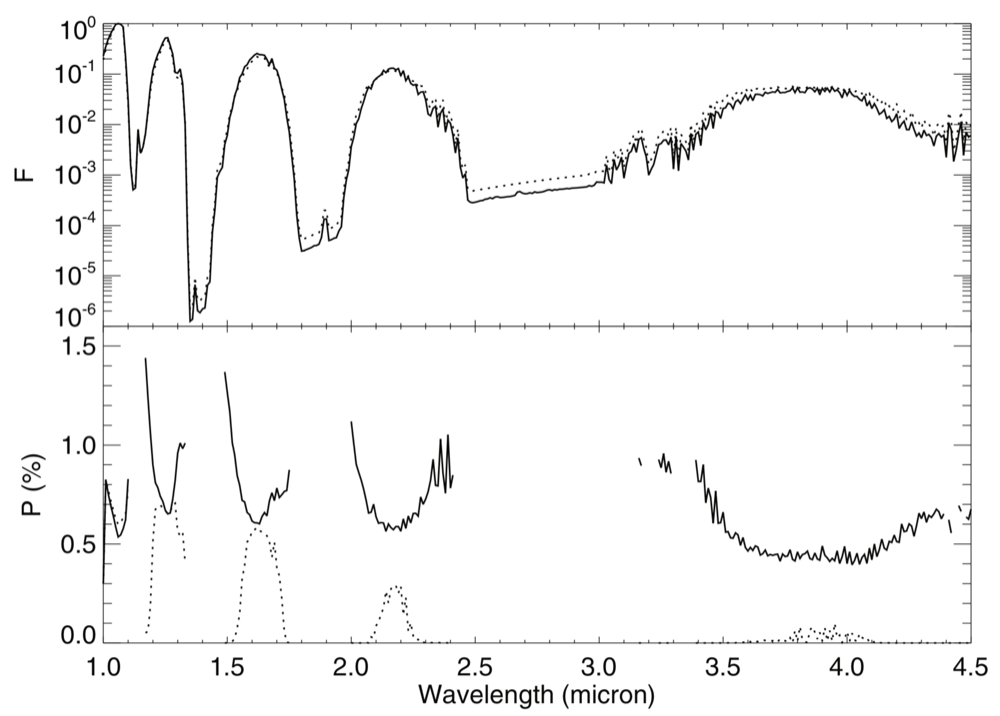
Polarimetry has the potential to revolutionize our understanding of cloud properties in exoplanets and brown dwarfs, by providing critical constraints on cloud morphologies, heights, compositions, and particle size distributions that are unavailable through other observational methods. Brown dwarfs are considered close relatives of directly imaged exoplanets and studying their atmospheres is an established way to make progress on understanding super-Jupiter atmospheres while side-stepping the challenges associated with observing an extremely faint object (a planet) next to a bright star. I am currently focused on two projects that use polarimetry to study brown dwarf atmospheres: polarimetric observations of the Luhman 16 brown dwarf binary and the WIRC+Pol Brown Dwarf Survey. As I look to the future, I'm interested in using polarimetry to study the atmospheres and surfaces of exoplanets seen in reflected light.
Luhman 16 HOT
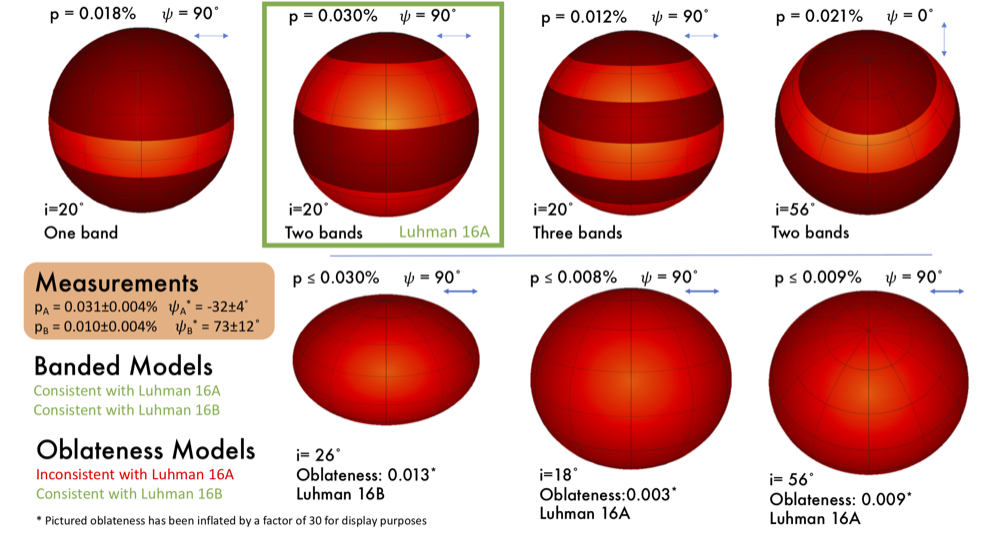
Luhman 16 is a binary brown dwarf system that is the third closest system to Earth! In 2018, I began investigating the binary system using the polarimetry mode of the NACO instrument at VLT. We were able to make very precise measurements of the two objects and found that the polarization measured for the A component can only be explained by banded clouds like we see in Jupiter, whereas the polarization measured from the B component could be due to either banded clouds or its inherent oblate shape. This result is incredibly exciting because it represents the first time that polarimetry has been used to carry out this type of cloud morphological study, and it opens the door to a range of new studies using polarimetry on other objects. This work has been published in ApJ.
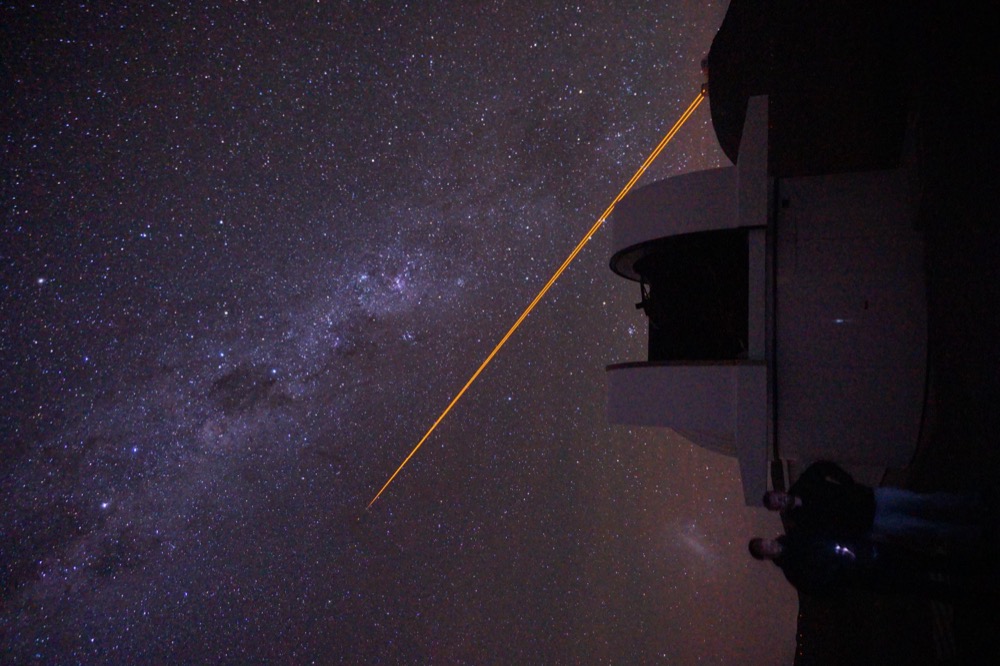
In April/May 2019, I returned to NACO with my collaborator Julien Girard to follow up this detection and search for time-variability in the polarization signature over 4 nights. During these nights we were also able to obtain simultaneous photometric monitoring with the Speculoos (pictured below) and Trappist telescopes in order to match variations in the targets' brightness with polarization variability. In this photo VLT can be seen in the top-right.
WIRC+Pol
WIRC+Pol is a polarization grating-based low spectral-resolution spectropolarimetry mode for the WIRC near-infrared camera at the Palomar 200-inch telescope. I am the project scientist for the WIRC+Pol project, an effort to use spectropolarimetry to understand the nature of the clouds in brown dwarfs. WIRC+Pol was first installed in Feb. 2017 and in 2019 I led the installation of a half-wave plate in order to reduce our instrument systematics to the levels needed to carry out a systematic survey across the L and T brown dwarf spectral types. We carried out a survey of ~20 brown dwarfs and we're in the process of writing up the results. Stay tuned! (See the WIRC+Pol instrument page for the hardware side.)