*** WELCOME TO THE UCSB EXOPLANET POLARIMETRY LAB HOMEPAGE ***Last updated: Oct 6, 2026NEWS · 2026-10-02: Recruiting a new graduate studentNEWS · 2026-10-02: Onward and upwardNEWS · 2026-08-25: First-light paper for the NIRC2 polarimeterNEWS · 2026-08-19: Dr. Rebecca ZhangNEWS · 2026-04-15: Postdoc Position at UC BerkeleyPlease sign our guestbook before you leave!Best viewed in Netscape Navigator 4.0 at 800x600
*** WELCOME TO THE UCSB EXOPLANET POLARIMETRY LAB HOMEPAGE ***Last updated: Oct 6, 2026NEWS · 2026-10-02: Recruiting a new graduate studentNEWS · 2026-10-02: Onward and upwardNEWS · 2026-08-25: First-light paper for the NIRC2 polarimeterNEWS · 2026-08-19: Dr. Rebecca ZhangNEWS · 2026-04-15: Postdoc Position at UC BerkeleyPlease sign our guestbook before you leave!Best viewed in Netscape Navigator 4.0 at 800x600
Millar-Blanchaer
Research Group
University of California, Santa Barbara
EXOPLANETS · POLARIMETRY · HIGH-CONTRAST IMAGING
THE GEMINI PLANET IMAGER ~/instrumentation/gpi
 The Gemini Planet Imager (GPI) is a high-contrast imager at the Gemini South telescope that combines an extreme adaptive optics system, a coronagraph and an integral field spectrograph/polarimeter in order to directly image exoplanets. I have worked extensively on GPI's polarimetry mode since about 2011, characterizing its performance (both in-lab and on-sky), developing data reduction procedures and using it for science.
Recently I demonstrated that GPI is sensitive to the polarization aberrations of the Gemini South telescope.
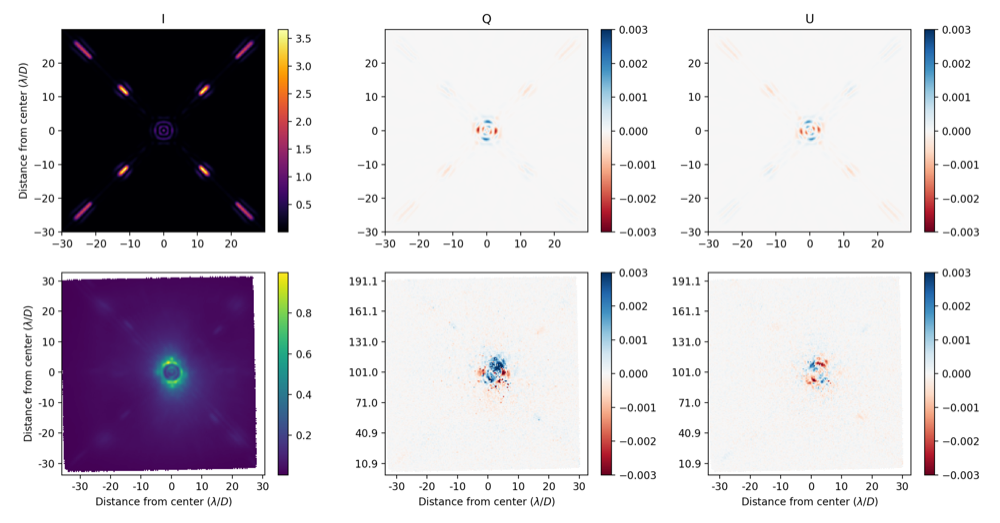
Here's a quick list of GPI papers I've written either characterizing GPI's polarimetry mode or using it for science:
- The polarization aberrations of the Gemini Telescope as seen by the Gemini Planet Imager
- Imaging an 80 au Radius Dust Ring around the F5V Star HD 157587
- GPI observational calibrations XIV: polarimetric contrasts and new data reduction techniques
- Beta Pictoris' Inner Disk in Polarized Light and New Orbital Parameters for Beta Pictoris b
- Polarization gratings for visible and near-infrared astronomy