Metasurface Optics
Metasurface optics have drawn significant interest over the last several years due to their unique ability to precisely control various properties of incident light. Metasurfaces are arrays of subwavelength nanostructures spatially distributed across a thin substrate. The nanostructures can be periodic, and can have relatively arbitrary geometry within the constraints of nanofabrication processes. The material properties, as well as the exact shape and pattern of the structures determine the optical effects on incident wavefronts. By appropriately designing specific nanostructures, metasurfaces have been demonstrated that can manipulate phase, amplitude, and polarization. We are currently exploring various metasurface applications in the Millar-Blanchaer lab, including focal plane and pupil plane coronagraphs. See these papers by Skyler Palatnick, one of my students: Prospects for metasurfaces in exoplanet direct imaging systems: from principles to design, Achromatizing photolithographically patterned metasurfaces with arbitrary, variable unit cell size, Investigating pathways for deep-uv photolithography of large-area nanopost-based metasurfaces with high feature-size contrast, Optimizing metasurfaces to achieve deeper direct imaging contrasts: analyses of current performance and lessons learned from fabrication, In-lab demonstration of a metasurface scalar-vortex coronagraph in a coronagraphic testbed
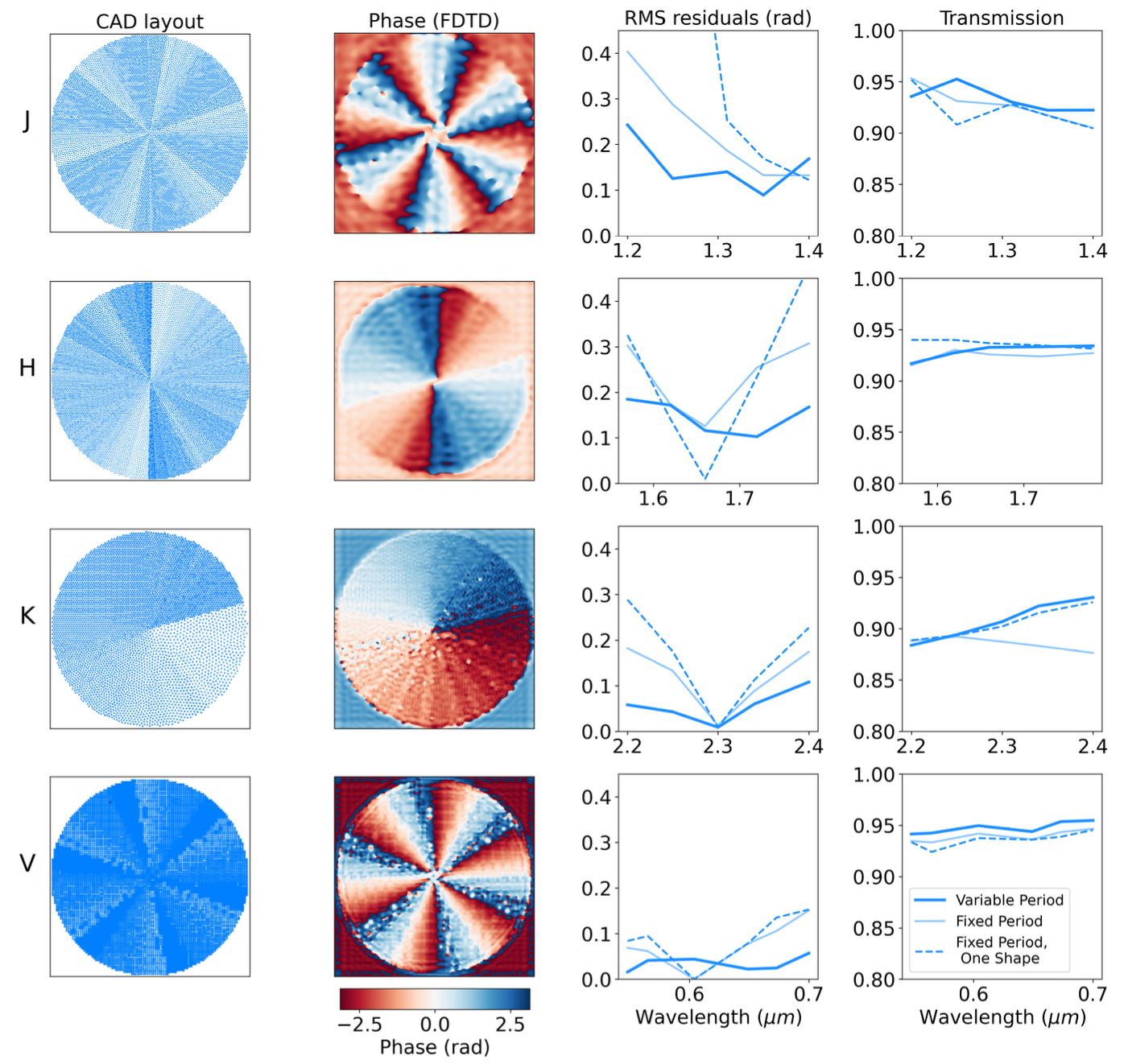
A gallery of different achromatic metasurface vortex designs from: Palatnick et al. 2023